
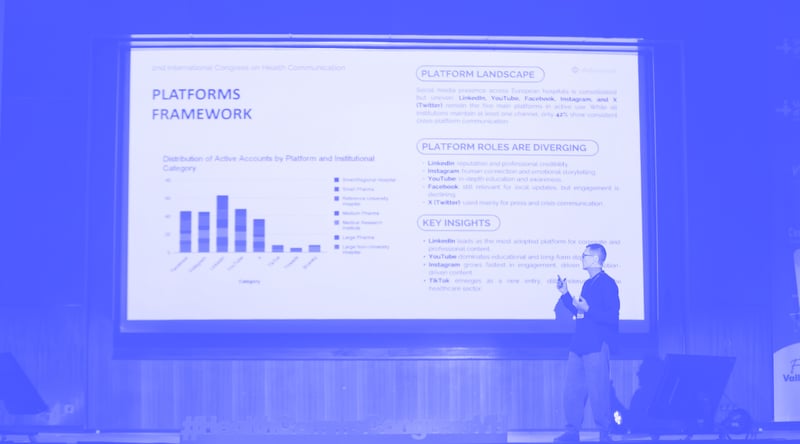
Social media communication in the European healthcare sector has reached a stage of digital maturity. A recent study by Zinkdo alongside Adsmurai, presented at the 2nd International Congress on Health Communication at the Vall d'Hebron Hospital Campus, offers a detailed X-ray of the digital strategy of 70 leading institutions across 10 European countries.
The report, titled “Digital Health Communication in Europe”, reveals how platform specialization, content quality, and the integration of Artificial Intelligence are redefining the relationship between hospitals and their audiences, placing human connection and credibility at the center of the strategy.
Study Context: Digital Maturity and Building Trust
The study analyzed the social media strategy of 70 leading healthcare institutions from 10 European countries, monitoring 264 active profiles on key platforms. The goal: to understand how hospitals and research centers build trust and engage with their audiences in the digital environment.
Platforms: Defined Roles and Leadership
The study reveals that LinkedIn is the most adopted social media platform in the healthcare sector (nearly 85%), establishing itself as the core for corporate reputation and professional credibility. It is followed by YouTube, Facebook, and Instagram.
- LinkedIn: Central for professional and thought leadership content.
- YouTube: Dominates in in-depth educational content and long-form storytelling.
- Instagram: Shows the fastest engagement growth, driven by emotional and human content, especially with Reels and carousels.
- Facebook: Maintains relevance for local updates, but its organic reach is declining, becoming a "community bulletin board."
- X (Twitter): Shows a sustained decline and is mainly used for press and crisis communication, with a loss of relevance in short text formats and brand safety issues.
- TikTok: Is the most dynamic platform in terms of engagement (rates 10 times higher than Meta) and is emerging as a key search engine for young audiences. It remains strategically underutilized by the sector, despite its potential for prevention and awareness campaigns.
Content and Frequency: Quality Trumps Volume
One of the key findings is that quality and relevance outweigh quantity. Healthcare institutions that post consistently (2 to 4 times a week) achieve higher engagement than those that over-post. Educational, preventive content, and human stories drive most interactions.
- Hospital Leadership: Hospitals (especially large non-university and reference university hospitals) dominate in posting frequency and engagement due to their local relevance and focus on community and patient care narratives.
- Pharmaceutical Lag: Pharmaceutical brands, particularly small and medium-sized ones, exhibit low and irregular posting frequency, suggesting a need to evolve toward more consistent, empathetic, and educational communication.
The Challenge of Health Communication on Social Media: From Visibility to Impact
Despite high activity on social media, the study identifies two main challenges:
- Fragmented Strategies: Few institutions manage their social media with a unified voice, which dilutes brand identity and weakens long-term engagement.
- Low Engagement Despite Activity: Content often focuses on institutional news rather than human stories or service-oriented communication, which patients value more. The result is "visibility without connection."
Strategic Recommendations for the Future
The future of social media communication in the healthcare sector will focus on:
- Visual Dominance: Short-form video (TikTok, Instagram Reels) will be the primary vehicle for simplifying complex concepts and communicating with authenticity. This can be achieved effectively through a solid content marketing strategy.
- Platform Consolidation: Strengthening the digital ecosystem, with LinkedIn as the center of authority, and Instagram and TikTok as centers for emotional and educational connection for younger audiences.
- Focus on Community and Reputation: Prioritizing trust and credibility over simple reach. Success is defined by the balance between scientific expertise and empathy.
- Artificial Intelligence (AI): Not only will AI be important for boosting strategies, anticipating needs and personalizing messages, but Google + AI will consolidate as the main entry point for healthcare information discovery, forcing institutions to adapt their content for new search dynamics and *overviews*.
Great Reception of the Study
The report “Digital Health Communication in Europe” has received excellent reception in media and social networks, especially on LinkedIn, where industry experts have highlighted the study's relevance. Media outlets such as La Vanguardia have echoed the conclusions, emphasizing the importance of artificial intelligence and empathy in redefining the relationship between hospitals and patients in the new digital era.
Ultimately, the success of social media communication in the healthcare sector will depend on a fundamental principle: Human connection above all else. Real innovation lies in translating data into meaning and emotion into action, transforming visibility into a measurable impact on health outcomes.
Ready to professionalize your digital presence on social media?
At Zinkdo, we believe every brand has a unique story to tell. We help you diagnose your digital presence, analyze your competitors, and build a solid strategy that boosts your impact on social networks. Interested? Contact us to learn more.